What does zest look like on a Tuesday afternoon?
A few years ago, I took a popular character strength test online.
It was a good survey, based on solid psychology rather than corporate buzzwords. When the results popped up, my top five traits were laid out in clean type: Zest, Love of Learning, Kindness, Curiosity, and Gratitude.
I felt a warm glow of pride. "Yes," I thought. "That sounds like me. Or at least the version of me I would like to be."
Then I did what almost everyone does after finishing a test like that. I closed the tab, went back to my inbox, and forgot all about it.
The trouble with such tests is that they hand you a list of flattering words and leave you there. Knowing you have "Zest" or "Curiosity" doesn't help you when you sit down at your desk tomorrow.
A strength only matters when you can answer one simple question:
What does it look like on a Tuesday afternoon?
Verbs, not badges
Most of us grew up with the idea that we should fix our flaws. If you brought home a school report with three As and a D, all the talk around the table was about the D. We spend years trying to pull our weak spots up to average.
There's another way to look at it. What if the goal is not to fix every flaw, but to give your natural strengths something real to do? To make that happen, you have to turn broad words into things you can actually do:
- Curiosity is not a mood. It is asking one honest question in a meeting instead of nodding along.
- Love of learning is not a certificate on a wall. It's spending an hour reading about stars or sourdough bread just because it's fascinating.
- Kindness is not just being a nice person. It's sending a quick note to a friend who is having a rough week.
- Zest is not jumping for joy. It's choosing to tackle the next chore with real energy instead of dragging your feet.
A strength only becomes useful when you can name the time, the place, and the action. If you cannot point to where it happens in your week, it's just wishful thinking.
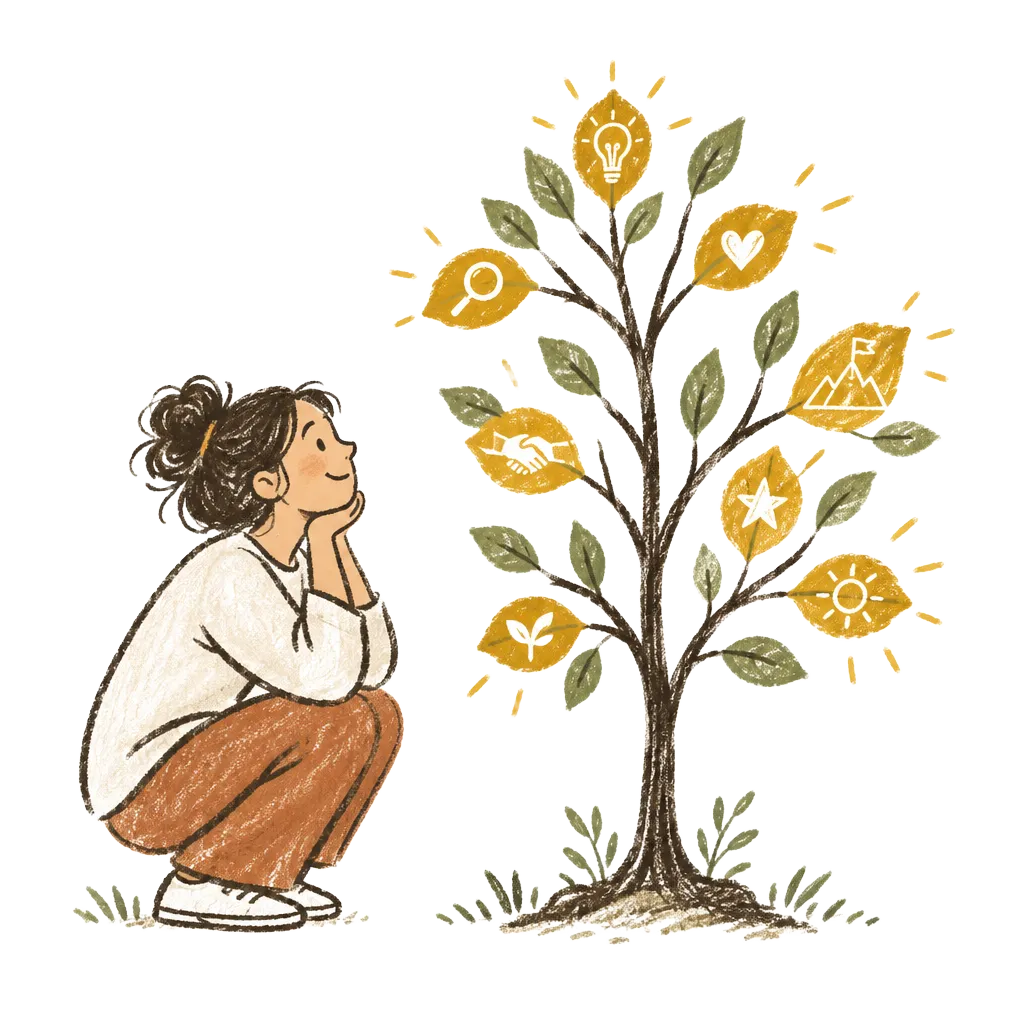
How they feed into each other
When you look at your best traits, you start to see how they connect. They don't work alone. They pass the ball to each other.
In my case, the top five flow naturally from one to the next:
- Curiosity: "I wonder how that works?"
- Love of Learning: "Let me read up on it."
- Zest: "Let us actually go build it or try it out."
- Kindness: "Who can I invite along, or how can this help someone?"
- Gratitude: "That was a great day. I'm glad I did that."
Whenever my week feels flat or frustrating, one of those steps is usually broken. Either I'm doing tasks without any curiosity, or I'm reading without ever trying things out, or I'm keeping completely to myself.
When all five are moving, the day feels lighter. It stops feeling like a grind and starts feeling like an adventure.
When strengths trip you up
There is a catch. Any good quality can cause trouble if you let it run wild.
- Curiosity can turn into pure distraction. You mean to look up one recipe and end up reading about privacy set-ups for two hours.
- Love of learning can turn into endless delay. You buy another book or take another class because you tell yourself you are not quite ready to begin.
- Zest can trick you into taking on far too much. You say yes to three exciting plans in one afternoon until your calendar is packed solid.
- Kindness can slip into people-pleasing. You take on everyone else's problems until you have no time left for your own life.
This is where your middle traits come in handy. You don't need to be a master of caution or self-control, but you do need them as gentle brakes.
Pairing energy with caution sounds like: "This project sounds amazing. But do I actually have time to do it well right now?"
Pairing curiosity with common sense sounds like: "Fascinating topic. I will save the link for Saturday morning."
The joy of pointless projects
Here's one thing that often gets missed: your strengths are not just for your job. You don't exist simply to get more work done.
If you are a curious, energetic person, you need things in your life that have no practical point at all.
Learn to play sudoku. Walk down a street you have never seen just to look at the houses. Draw a silly cartoon. Listen to an album in a style of music you normally ignore. Bake something complicated.
Don't ask how it helps your career. Don't worry about turning it into a side hustle. The only test is simple: "Does this make me feel more alive?"
A good life needs plenty of room for things you do purely for the fun of it.
A gentle check-in
You don't need a complicated new planner to make this work. Turning your strengths into another chore defeats the whole purpose.
If you want to try this out, set aside ten minutes at the end of the week. Sit down with a cup of tea and ask yourself three questions:
- When did I feel most alive this week?
- What did I discover or try that genuinely interested me?
- Which strength do I want to use on purpose next Tuesday?
Don't treat your strengths as another self-improvement test you have to pass. Treat them as clues for how to build a life that feels lively, generous, and completely yours.